
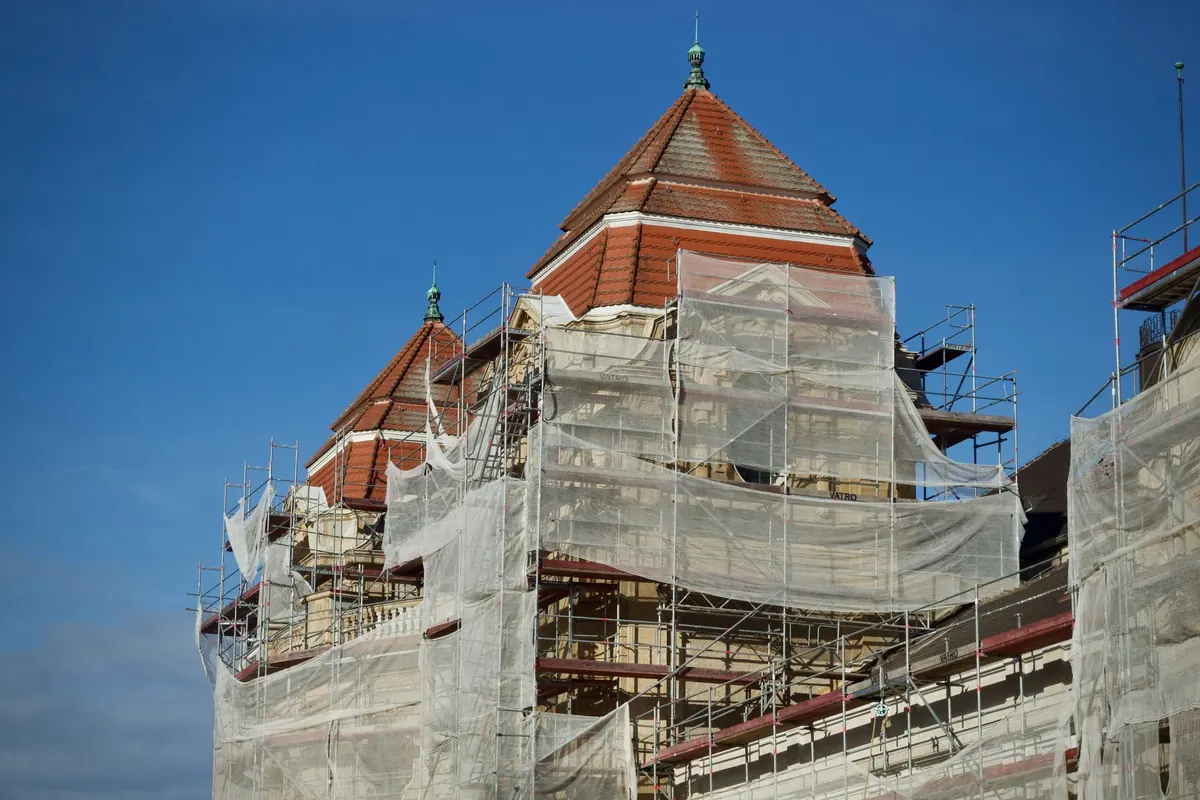



Scaffolding is rarely a sign of decline. At abbeys and monastic sites across Britain, Ireland and continental Europe, it usually means someone has finally raised the money to fix something that has been failing quietly for decades: a gutter, a lead roof, a stretch of wall where hard cement pointing is holding water against the stone.
Conservation moves slowly, which makes it easy to miss. A project announced in spring may not touch the fabric until late summer. A reopening might mean one chapel rather than the whole site. What follows is a plain guide to the kinds of work worth watching this year, and what each one actually involves.
Three Pressures Shaping This Year's Programmes
Almost every abbey conservation plan is being written around the same three constraints. The first is water. Wetter winters and more frequent storm events mean gutters, drains and roofs that coped twenty years ago now overflow into walls. The second is money, which arrives in grant cycles, so work is phased across several years rather than done in one push. The third is use: many abbeys are still working churches as well as visitor sites, with services, weddings, concerts and school groups to accommodate.
That is why the timetable in a newsletter rarely matches the timetable on the ground. If a site near you has announced a repair programme, expect access routes to shift, car parks to shrink and one or two areas to close without much warning. It is worth checking the website the day before you travel.
Roofs, Gutters and the Water Problem
Water does more damage to historic masonry than centuries of weather. So most structural repairs begin at the top: replacing failed lead or slate, clearing and re-forming gutters, renewing hoppers and downpipes, and adjusting ground levels and drainage so water runs away from the walls instead of sitting against them.
Survey teams use drones, thermal imaging and endoscopes, but plenty of useful information still comes from someone standing in a tower with binoculars and a notebook. If you are following a project, this is the phase to watch, because it is the least glamorous and the most consequential. Repointing a wall before the roof above it is watertight is money spent twice.
Lime Mortar, and Why Repairs Take Seasons, Not Weeks
Hard cement pointing is one of the most common causes of decay in medieval walls. It is stronger and less breathable than the stone around it, so moisture trapped behind it has nowhere to go. Salts crystallise, the face of the stone spalls away, and the damage spreads.
Lime mortar works differently. It is softer and more porous than the stone, so it moves and breathes, and it fails before the stone does. Good practice means matching the mortar to the original in colour, texture and aggregate, working it into raked-out joints by hand, and finishing the joint profile so water sheds rather than pools. Because it is applied with small tools in small quantities, a team may cover only a modest area in a day.
The consequence is that a project described as "repointing the south aisle" can run for a season or more, and the visible change from a distance is subtle. Photographs taken from the same spot each month are often the best way to see progress. If you are supporting a specific site, ask what the current phase is, not just what the total appeal figure is.
Fragments: Manuscripts, Floor Tiles and Buried Foundations
Restoration is not only about stone. Monastic collections need care too: charters and bound volumes kept in stable, moderate humidity; medieval floor tiles lifted, cleaned and re-laid; wall paintings consolidated by a specialist conservator; carved fragments recorded and stored rather than left in a damp corner.
Ground disturbance also triggers archaeological work. Laying a new drain or a service trench across an abbey precinct will usually require a watching brief, and it is remarkable how often a pipe run turns up the footings of a lost cloister range or a earlier floor. Finds are recorded, and human remains are treated with care and normally reinterred. This is often the most interesting part of a project to follow, and site newsletters usually report it first.
Where the Money Comes From
Funding for abbey work is usually assembled from several sources rather than one large grant. A typical package might include:
- National and regional heritage grant programmes, often covering part of a phased scheme and requiring match funding.
- Church and denominational trusts, which frequently support roofs, masonry and heating.
- County, city and local amenity trusts, whose grants are smaller but quicker to secure.
- Friends' organisations, membership schemes and regular giving, which provide the steady income that pays for professional fees and surveys.
- Legacies, which often underwrite a whole phase of work.
- Sponsorship and apprenticeship funding, particularly where the project includes training in traditional skills.
- Public appeals, best used for a clearly defined, visible piece of work rather than a general pot.
If you are considering a legacy or a substantial gift, and especially if tax relief or a trust is involved, take professional financial and legal advice before committing.
Reopenings and Visiting While Work Continues
A reopening often means partial reopening. Scaffold tours, hard-hat visits and conservation open days have become a genuine part of how sites explain their work, and they are usually cheap or free. Book early; numbers are limited and these fill quickly.
Expect some photography restrictions near loose masonry or open excavation, and respect cordons even when a path looks passable. Morning and late afternoon are usually quieter than midday. If a chapel or cloister is closed, ask what else is open: the undercroft, the tower, the site museum and the tea room often carry on regardless.
Practical Ways to Help
If you would like your interest to be useful rather than just sympathetic, these steps work:
- Pick one site close enough to visit twice a year, and follow its project updates.
- Ask what is needed now. It might be £40 for lime mortar, a set of waterproofs for volunteers, or help with a mailing list.
- Give unrestricted funds if you can. Surveys, scaffolding and professional fees are the costs that appeals struggle to cover.
- Offer skills, not just hours: photography, bookkeeping, event stewarding, gardening and archive indexing are all in demand.
- Buy something on site. Shop and café income is often less restricted than grant money.
- Check opening times before travelling, especially during a repair phase.
None of this is dramatic, and that is the point. Abbey restoration is mostly a long sequence of small, careful decisions, made in the right order, by people who will not see the finished result themselves. Watching that process closely, and paying for a few metres of pointing now and then, is the most useful thing most of us can do.
Photo: Peter Dyllong / Pexels
Related posts
More stories you’ll love reading